 |
| Handy Tripod Adjustment Click Image to View Larger |
Showing posts with label Induro Tripod. Show all posts
Showing posts with label Induro Tripod. Show all posts
Wednesday, August 11, 2010
Quick Tip: Handy Tripod Adjustment Technique
Here's a quick tip for you regarding tripod adjustment. When I bought the Induro CT314 tripod I knew it would extend to a height taller than eye level for me. I've been trying to figure out a way to quickly adjust the tripod to my working height when setting it up. I realize each time you use it you may have to do some tweaking here and there but I was trying to figure out a quick way to get to a basic starting point. I had considered adjusting it and then paintiing a stripe around the tripod legs but decided against that because it just seems wrong to cover up those beautiful carbon fiber legs :). After trying all kinds of different ideas: width of camera body, length of lens, length of a dollar bill, etc I finally came up with something that works and I'll never forget to bring 'em.
That's right my hands are what I use to get the base tripod settings. What I do is fully extend the bottom and middle legs and then extend the top leg the width of my two hands. This gives me nice starting point for setting up the tripod. From here I can easly adjust each leg up or down as needed.


Ground Pod Working Height
As I have experimented with DIY Ground Pod ideas one thing that has come to mind is what is the working height of the ground pod. Afterall what good is having a Ground Pod if you have to contort yourself into a pretzel to use it?! With this in mind I setup my gear on the PVC Ground Pod, Frying Pan Ground Pod and Induro Tripod with legs fully splayed.
Working height for the PVC Ground Pod is approximately 10 inches with Gimbal Head installed.
Working height of the Frying Pan Ground Pod is approximatley 11 inches with Gimbal Head installed. I've done some shooting with this setup and it works pretty. What's cool, silly as it sounds, is the sound that resonates through the frying pan when you click the shutter.
Working height is a little less than 16 inches when using the Induro CT314 tripod with Gimbal Head installed. I'm beginning to think I may not need a Ground Pod afterall. My Induro Tripod gets me within a few inches of the other two solutions and I'll always have my Induro Tripod with me. I guess I'll know for sure after I've had a chance to try all of the different soltuions out in the coming days.
For those of you that have a Ground Pod, either store bought or DIY what's your approximate working height? I realize there's numerous factors such as ballhead height, Gimbal Head height, etc but I'd be curious to know how low your ground pod gets you.
 |
| Working Height PVC Ground Pod Click Image to View Larger |
 |
| Working Height of Frying Pan Ground Pod Click Image to View Larger |
 |
| Working Height of Induro Tripod Click Image to View Larger |
For those of you that have a Ground Pod, either store bought or DIY what's your approximate working height? I realize there's numerous factors such as ballhead height, Gimbal Head height, etc but I'd be curious to know how low your ground pod gets you.
Thursday, July 29, 2010
Induro Gear Guide Part 3 - Induro BHD3 Ballhead
Welcome to part 3 of my Induro Gear Guide. In this part we'll take a look at the Induro BHD3 ballhead. I don't know what BHD really stands for but to me it means Big Heavy Duty and that's a good thing! This ballhead is a beast and I couldn't be happier with it. According to the Induro web site it weighs 2.2 pounds and is rated for a maximum load of 55 pounds. While I doubt I'll never have any camera gear that is that heavy it's nice to know I'll not outgrow this ballhead anytime soon.
Mounting the ballhead to the tripod is as simple as screwing it on. One feature that I probably should have covered when writing about the tripod and is absolute genius, in my opinion, is the inclusion of set screws in the base of the tripod head. After screwing the ballhead onto the base you can tighten the set screws to securely lock the ballhead onto the tripod center column. I can't tell you how many times with my previous setup that I'd pan to the left only to have the ballhead start to come loose from the tripod center column. I probably could have fixed it with a little locktite but I didn't have any at the house and never remembered to buy any when I was shopping at the local Lowes.
Once mounted on the tripod you can mount your camera or lens using any Arca-Swiss compatible quick release plate. I have several universal ones that I bought off of eBay that I use with various cameras and lens tripod collars. Kirk Enterprises sells universal plates for $17.00 each and I bought enough for each camera body and tripod collar that I own. This allows me to attach the plate to each camera/lens and leave it there instead of having to swap it out when I want to use a different camera/lens.
To facilitate with balancing your camera/lens the quick release mount on the tripod and some quick release plates come marked with a center line. By aligning these two marks the camera/lens is centered properly on the ballhead as shown below. Also notice that the plate installed is longer than the tripod mount. This allows you to either slide the plate forwards or backwards as needed to customize the balance. For example I may mount the lens centered as shown when shooting with the Rebel T2i because it's lighter than my 7D. When I shoot with the 7D I may adjust the position slightly forward or backwards to adjust for the heavier camera body.
The beauty of using a ballhead is that you have a virtually infinite amount of positions you can use to position the camera. This takes a bit of getting used to at first but once you use one for any length of time you'll never want to go back to using a regular tilt/pan head. By adjusting the various knobs on it you can control just how much tension is required to move the camera/lens. If I'm shooting a static subject I'll often lock the ballhead in place to make sure I have the most stable platform possible. Also, notice the notch cut into the side of the ballhead. This allows you to rotate the camera/lens combination to the side. This makes it possible to shoot in either a horizontal or portrait mode without having to remove the camera. If you're shooting with a lens that thas a tripod color like the EF 400 does then you can loosen its tension knob and rotate the camera which is very handy.
With the ballhead adjusted over to the side as shown below you can actually use it like a Gimbal Head in a pinch but as you'll see in part 4 using a Gimbal Head is SO much nicer than trying to use this setup. Something else I would do is instead of positioning the knob down as shown below I would position it towars the top so that it doesn't hit against the ballhead body.
I have no doubt that this ballhead will exceed my needs regardless of which camera/lens I mount on it. Is there anything I don't like about it? Glad you asked I have one minor nit and I honestly shouldn't mention it because it's so trivial. The knob on the bottom left in the picture above is the knob that controls how much tension is applied when you rotate the ballhead. Despite loosening it as far as it will loosen the ballhead still requires more resistance than I would expect to rotate the camera. See, I told you I shouldn't have mentioned it. As I think about it more I really can't fault the ballhead for this. It's designed to deal with loads up to 55 pounds and I may be putting what 5 or 6 pounds of weight on it at this point in time. It's no wonder it's stiff I'm only using about 1/10th of the ballheads capacity. Something else to keep in mind is I've only had this ballhead a few weeks so it hasn't been used enough to get broken in. Check back with me in 6 months time and we'll see if this continues to be an issue for me or not. I seriously doubt that it will.
One final thought - I'll be honest and say that I was seriously considering the Really Right Stuff (RRS) BH55 Ballhead. Several big name photographers use it and rave about how great it is and I have no doubt that it's a very fine Ballhead; however when you consider the BHD3 is less than half the cost of the RRS Ballhead the decision became a non brainer for me. I went with the Induro BHD3 and I had enough $$$ left over to buy the GHBA Gimbal Head that I'll be writeing about next. Cost for the Induro BHD3 Ballhead - $228.00. The link below is for the Ballhead on Amazon. If you use it to purchase one I'll receive a little commission and you'll buy an absolutely fantastic Ballhead.
 |
| Induro BHD3 Ballhead |
 |
| Canon 7D mounted on BHD3 Ballhead |
 |
| Canon EF 400 f/5.6L Lens |
 |
| Ballhead and Mounting Plate Alignment Marks |
 |
| Cutout on Side of Ballhead |
 |
| Lens Mounted Sideways |
One final thought - I'll be honest and say that I was seriously considering the Really Right Stuff (RRS) BH55 Ballhead. Several big name photographers use it and rave about how great it is and I have no doubt that it's a very fine Ballhead; however when you consider the BHD3 is less than half the cost of the RRS Ballhead the decision became a non brainer for me. I went with the Induro BHD3 and I had enough $$$ left over to buy the GHBA Gimbal Head that I'll be writeing about next. Cost for the Induro BHD3 Ballhead - $228.00. The link below is for the Ballhead on Amazon. If you use it to purchase one I'll receive a little commission and you'll buy an absolutely fantastic Ballhead.
Wednesday, July 28, 2010
Induro Gear Guide Part 2 - Induro CT314 Tripod
Welcome to part 2 of my Induro Gear Guide. In this part we'll take a look at the Induro CT314 Carbon Fiber tripod. I'll provide a description of the tripod, its features as well as things I like and don't like about it. This post is heavy with pictures so it may take a bit to load. When looking for a new tripod I wanted something that would work with my equipment now as well as something that would work with my equipment 5 or 10 years from now. I know at some point in the future I'll be getting one of Canon's super telephoto lenses and those work best on a tripod. I also consider the tripod as the foundation for my photography gear so like a house, if it's built on a solid foundation you should be good to go. Weighing in at 5 pounds the CT314 tripod is rated for a maximum load of approximately 40 pounds.
This is how the tripod looks when you take it out of the box. In addition to the tripod you get a carrying case and a tool pack as pictured below.
Having an extra long center column is a nice addition but it also has its drawbacks. One of them being that it limits how low you can position the camera on the tripod as you'll see shortly.
Before anyone bothers to tell me yes I know the center column isn't straight :). That's my fault and not the fault of the tripod. I just didn't lock one of the legs properly. Crooked center column aside you can see that with the legs splayed into the first position you can get down fairly low with the tripod.
Notice how the center column is straight this time. See I'm a quick learner :). Here you can clearly see one of the drawbacks of the extra long center column. You can only get your camera so low using it. Fortunately Induro has a solution to the problem. They sell a separate column that is shorter and allows you to get down very low.
I've never used the tripod with the longer center column. I knew I wanted to be able to get down in the weeds, literally, with the tripod so I bought the shorter center column and that's all I've used.
Now that's what I'm talking about. With the short center column installed and the legs fully splayed you can get down low for those ground level shots.
The tripod includes a spring-loaded hook that attaches to the bottom of the center column. You can hook your bag or something else to it to get the tripod that much more stability (not that it really needs any). One problem for me though is the hook just isn't quite big enough to fit around the handle of my camera backpack as shown below.
Don't fret though, I have a simple solution for the problem.
By using a large carabiner I'm able to hook one end around my camera backpack handle and the other on the hook. This works like a champ.
I realize the third photo makes the tripod look 10 feet tall. It isn't. That's due to the angle I shot it from.
To give you some idea of the height of the tripod the fence behind it is 6 feet tall.
See that locking ring above. Make sure it's nice and tight otherwise you're liable to think there's something wrong with the tripod when there really isn't. Don't ask me how I know this tidbit of knowledge -- it's a secret :).
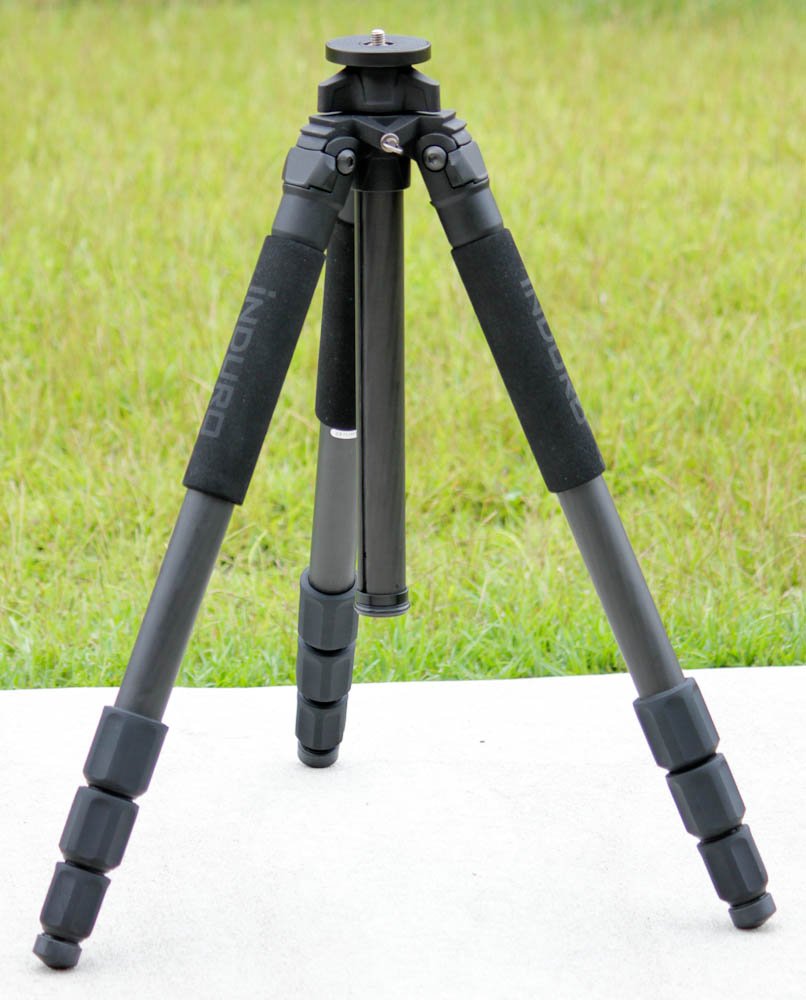 |
| Induro CT314 Tripod |
 |
| Included Tools and Tool Case |
 |
| Tripod with Center Column Fully Extended |
 |
| Tripod With Legs Splayed and Locked |
 |
| Tripod With Legs Fully Splayed |
 |
| Extra Long and Optional Shot Center Columns |
 |
| Tripod Fully Splayed With Short Center Column Installed. Photo assistant Tiger. |
The tripod includes a spring-loaded hook that attaches to the bottom of the center column. You can hook your bag or something else to it to get the tripod that much more stability (not that it really needs any). One problem for me though is the hook just isn't quite big enough to fit around the handle of my camera backpack as shown below.
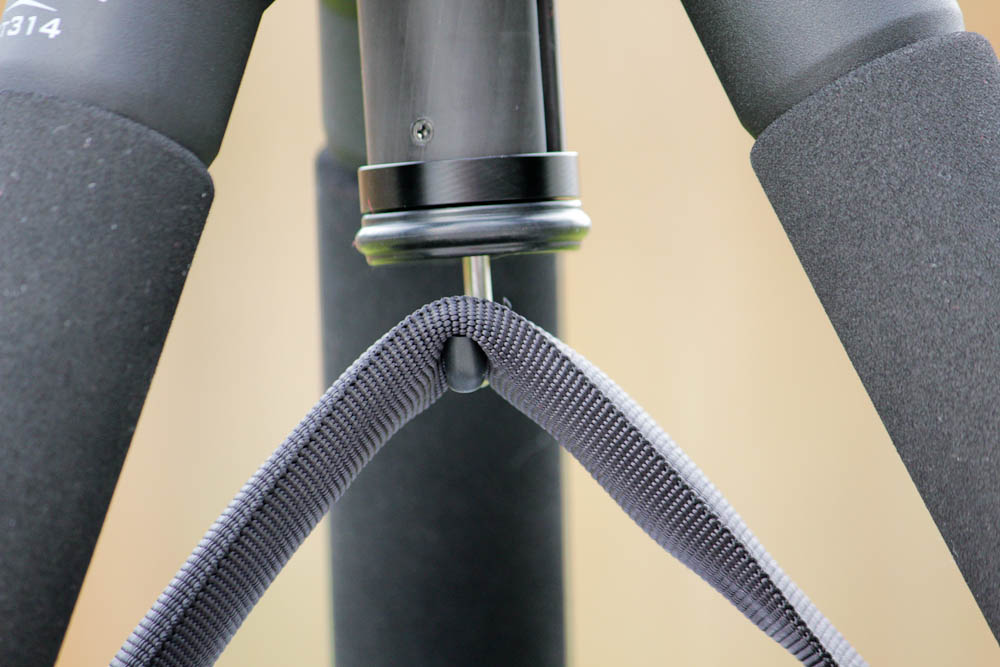 |
| Camera Bag and Tripod Hook |
 |
| Camera Bag and Tripod Hook -- Problem Solved |
As I mentioned in part 1 one of the issues I had with my old tripod was that it wouldn't extend high enough for me to use without squatting down. That problem was easily solved with this tripod.
 |
| Tripod with Bottom Legs Extended |
 |
| Tripod with Bottom and Middle Legs Extended |
 |
| Tripod With All Three Legs Extended |
 |
| Tripod With All Three Legs Extended |
 |
| Tripod Center Column Locking Ring |
Overall I'm extremely pleased with the tripod. I can't thank Eric Brown enough for his review which turned me onto Induro's product line. Although I am extremely pleased with it there are a couple of things I didn't like but have managed to solve bot of them quite easily. First I didn't like that the tripod only comes with the long center column. The short column is a $55.00 accessory. It would be nice if Induro offered the tripod with our choice of center columns. The second being spring loaded hook on the bottom of the center column not being long enough to accommodate my particular backpack; however, that problem was easily solved with the addition of a large carabiner. Am I being overly picky about my dislikes? Probably so especially since I was able to solve both issues easily. It's tough for me to find any serious fault with the tripod. I have no doubt it'll be supporting my gear for years to come. Total cost for tripod and short column: $605.00 and worth every penny of it.
As I use the tripod in the coming months I'll be certain to post follow ups about it. I plan to include shots of it being used out in the field. It's nice to see it on a clean concrete pad but just how often do we shoot from that environment?
So what didn't I cover that you think I should have? Please let me know where details are lacking and I'll add them. If you prefer to email me privately instead of leaving a comment send them to zack at zdpictures dot com.
So what didn't I cover that you think I should have? Please let me know where details are lacking and I'll add them. If you prefer to email me privately instead of leaving a comment send them to zack at zdpictures dot com.
If after reading this fantastic guide and feel inclined to buy one of these tripods I'd appreciate if you'd use the link below. It's an affiliate link from Amazon and if you buy I'll earn a small commission.
Tuesday, July 27, 2010
Induro Gear Guide Part 1 - Introduction
Not long ago I posted a photo of my Canon PowerShot D10 mounted on my Induro Tripod/Ballhead. (Link to Previous Post). Below is a similar shot but this is my advanced set up for birding :).
Pictured is the Induro CT314 tripod, BHD3 Ballhead, and GHBA Gimbal head. This is the setup I now use for 99% of my shots taken with a camera mounted on a tripod. Normally I use a 7D and EF 400 lens and not that dinky Powershot D10. Over the next few days I'm planning to post reviews of each of these components.
Prior to buying this Induro gear I had been using a Velbon tripod and Kirk BH-3 ballhead. I liked this combination because it was light but there were a couple of major drawbacks with it. First the Velbon tripod did not extend high enough for me to use it without squatting down. As I have grown to use a tripod more and more this became a major problem. It was possible to get the camera to eye level but I had to extend the center column to do so and extending it just made things unstable. The Kirk BH-3 ballhead is a very nice one but it was rated for a maximum load of 15 pounds. While this may sound like a lot of weight I was experiencing some slippage with the ballhead. Upon returning the ballhead to Kirk they replaced it, no questions asked. Kudos to Kirk for the fine customer service. I'm going to sell the Kirk ballhead on eBay and stick with my current Induro one instead because the new ballhead is rated for a much heavier load and eventually I'm planning to add the Canon EF-500mm monster lens to my collection.
Investing in a tripod setup is something I spent a lot of time researching and fretting over. I knew I wanted something that would extend high enough that I wouldn't have to squat down and I also wanted something that would get down low to the ground. This was an essential requirement because I like shooting stuff up in the sky or trees and Donna likes shooting flowers so I wanted a tripod that would meet both our needs. I wanted it to be relatively light and rock steady. I find it somewhat funny when folks complain about the weight of their gear. If you don't want to lug around an extra 5 pounds then lose 5 pounds from your body :). While the new tripod setup is heavier than my old setup I'm kind of like an old pack mule -- the weight difference between the two isn't great enough that I've noticed any difference. I spent hours reading reviews and forum posts to find out which tripods people liked and didn't like and why. Gitzo was the name I saw most often and so I started leaning heavily towards Gitzo.
While doing my research I found the Photography Minute Blog by Eric Brown. Since he's a fellow Canon 7D and EF 400 shooter I knew his tripod needs were similar to mine. After reading his Induro CT314 Tripod Review I started looking at Induro's gear and it wasn't long before I knew I had found the compnay that I would be buying my tripod gear from.
In my reviews over the next few days I plan to write about the thinks I like and don't like about each of the products I now own. Hopefully this information will help the next person considering such an upgrade have an easier time making a decision that I had when I went through it. If you're reading this and are undecided and don't want to read all of the other posts here's the answer to the $64,000 question -- buy Induro. You'll love it.
As I write the reviews the text below will be turned into links to those reviews.
Induro Gear Guide Part 2 - Induro CT314 Tripod
Induro Gear Guide Part 3 - Induro BHD3 Ballhead
Induro Gear Guide Part 4 - Induro GHBA Gimbal Head
Induro Gear Guide Part 5 - Balancing Your Camera/Lens on the GHBA Gimbal Head
Induro Gear Guide Part 6 - Wrap up
 |
| Advanced Tripod Setup |
Prior to buying this Induro gear I had been using a Velbon tripod and Kirk BH-3 ballhead. I liked this combination because it was light but there were a couple of major drawbacks with it. First the Velbon tripod did not extend high enough for me to use it without squatting down. As I have grown to use a tripod more and more this became a major problem. It was possible to get the camera to eye level but I had to extend the center column to do so and extending it just made things unstable. The Kirk BH-3 ballhead is a very nice one but it was rated for a maximum load of 15 pounds. While this may sound like a lot of weight I was experiencing some slippage with the ballhead. Upon returning the ballhead to Kirk they replaced it, no questions asked. Kudos to Kirk for the fine customer service. I'm going to sell the Kirk ballhead on eBay and stick with my current Induro one instead because the new ballhead is rated for a much heavier load and eventually I'm planning to add the Canon EF-500mm monster lens to my collection.
Investing in a tripod setup is something I spent a lot of time researching and fretting over. I knew I wanted something that would extend high enough that I wouldn't have to squat down and I also wanted something that would get down low to the ground. This was an essential requirement because I like shooting stuff up in the sky or trees and Donna likes shooting flowers so I wanted a tripod that would meet both our needs. I wanted it to be relatively light and rock steady. I find it somewhat funny when folks complain about the weight of their gear. If you don't want to lug around an extra 5 pounds then lose 5 pounds from your body :). While the new tripod setup is heavier than my old setup I'm kind of like an old pack mule -- the weight difference between the two isn't great enough that I've noticed any difference. I spent hours reading reviews and forum posts to find out which tripods people liked and didn't like and why. Gitzo was the name I saw most often and so I started leaning heavily towards Gitzo.
While doing my research I found the Photography Minute Blog by Eric Brown. Since he's a fellow Canon 7D and EF 400 shooter I knew his tripod needs were similar to mine. After reading his Induro CT314 Tripod Review I started looking at Induro's gear and it wasn't long before I knew I had found the compnay that I would be buying my tripod gear from.
In my reviews over the next few days I plan to write about the thinks I like and don't like about each of the products I now own. Hopefully this information will help the next person considering such an upgrade have an easier time making a decision that I had when I went through it. If you're reading this and are undecided and don't want to read all of the other posts here's the answer to the $64,000 question -- buy Induro. You'll love it.
As I write the reviews the text below will be turned into links to those reviews.
Induro Gear Guide Part 2 - Induro CT314 Tripod
Induro Gear Guide Part 3 - Induro BHD3 Ballhead
Induro Gear Guide Part 4 - Induro GHBA Gimbal Head
Induro Gear Guide Part 5 - Balancing Your Camera/Lens on the GHBA Gimbal Head
Induro Gear Guide Part 6 - Wrap up
Subscribe to:
Posts (Atom)