Showing posts with label Product Review. Show all posts

Wednesday, December 28, 2011

Induro Adventure AKB0 Tripod Review - Introduction

Ever watch the John Belushi movie Continental Divide? If not it's the story of a Chicago journalist that goes up into the mountains to write and article about an Eagle researcher. There's one scene where he's down to his last cigarette and he's in a world of hurt because he's out of shape and has been huffing and puffing his way up the mountain to see what this Eagle researcher does. That's pretty much how I was feeling the day that Donna and I set out to find one of the waterfalls in upstate South Carolina that was listed as "moderate" in difficulty. Clearly the person that rated it moderate must be part mountain goat because that hike for us was down right hard! Of course it doesn't help being out of shape and lugging my camera backpack with extra lenses and my Induro CT314 tripod with me. Long story short Donna and I made it to the waterfall, got some great pictures and made it back to the car without killing ourselves. One valuable lesson I learned that day was traveling light is the way to go on waterfall hikes and hauling around my camera backpack and heavy duty tripod was clearly not traveling light!

Thus began my quest for a lightweight tripod to use when shooting waterfalls. Since I'm obviously a huge Induro fan I checked out their tripods first and read about the Adventure AKB Series of tripods. These lightweight tripods come with matching ball head and carrying bag. They are available in three sizes: AKB0 which is designed for loads up to 10.3 pounds and weights 2.6 pounds, the AKB1 which is designed for loads up to 12.8 pounds and weighs 3.6 pounds, and the AKB2 which is designed for loads up to 18.7 pounds and weighs 4.2 pounds. For comparison my CT314 and BHD3 ball head are designed for loads up to 40 pounds and weigh 7.2 pounds. I spent a good amount of time reading about these three tripods but couldn't decide which one I wanted. My first choice was the AKB2 thinking that it even though I wouldn't be coming close to its load capacity that it would be better to have a tripod that can support way more than I would need but it weighs nearly double what the AKB0 weighs and I really wanted to go as light as possible. I knew that the good folks at Induro had read my previous write up I had done on the CT314 and ball head so on whim I contacted them and told them I was in the market for a lightweight tripod and wanted to know if they happened to have any of the AKB series tripods available for a trial basis. I figured they may have some that didn't meet QC specs or something like that they would be willing to send me. They said they did have something I could test with, faxed me the agreement which I signed and faxed back and a few days later the UPS box arrived.

Inside was not a some loaner tripod that has been used by others and was passed along to me but instead it was a brand new AKB0 tripod. Our agreement was for me to keep the tripod for a few weeks, test it thoroughly and then return it to Induro. For this review I plan to document the following aspects of the tripod:

  • Introduction - this post
  • The Tripod
  • The Ball Head
  • Use in the Field
  • Short Post Accessory
  • Comparison to the CT314
  • Summary

Induro Adventure AKB0 Tripod with Donna's Canon Rebel T2i with 18-200 lens

Monday, January 11, 2010

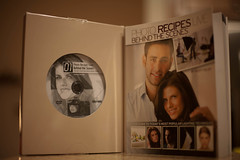
Photo Recipes Live Behind the Scenes Review


Fantastic!
Originally uploaded by
zackojones


Below is my review of Scott Kelby's DVD/Book combo: Photo Recipes Live Behind the Scenes.


Chapter 1 - Window Light Portrait (9:51 in duration) - Shows you how to use natural light from a window and a hand held diffuser to soften the harsh light coming in from the window. It also shows you how to check for blown highlights or blinkies as they are called. More importantly Scott shows you how to correct the blinkies problem. A very cheap alternative to the hand held diffuser that Scott users (which sells for $65.00 at B&H) is to buy a 99 cent semi-transparent shower curtain at your nearest wally world or dollar store. Granted the shower curtain is no where near as cool as the hand held diffuser but it works well enough for me.

Chapter 2 - Couples Portrait (9:44 in duration) - Shows you how to overcome problems you'll have when you have a brightly back-lit couple. Scott demonstrates various techniques such as using silver reflector to reflect some of the bright light from the background. As he demonstrates each technique you can see the resulting image. He explains why something works or doesn't work quite as well as expected. He shows you how to use a soft-box and the advantage of using a "hot" box (one where the lights are always on) when trying to solve the lighting problems he's trying to solve.

Chapter 3 - 3-Light Setup (10:14 in duration) - Shows you how to use 3 separate light sources to create a dramatic portrait. Two of the lights are located behind the subject and provide the light source for the sides of his face and the 3rd light is a softbox located in front of the subject to provide some fill light. Pay attention to Scott's facial expressions right around the 1:00 minute mark. For some reason he goes into what I would call Popeye mode where he closes one eye but continue talking. It reminded me of Popeye for some reason. I wonder if he was holding back a sneeze or something. Scott also shows you how to identify lens flair in your photo and how to correct it.

Chapter 4 - Clamshell Lighting - Part 1 (9:43 in duration) Shows you how to use either a single light and reflector or two lights to achieve the look. He explains the equipment needed to wirelessly trigger the strobes.

Chapter 5 - Clamshell Lighting - Part 2 (7:38 in duration) This is an expansion of chapter for of sorts. It shows you how to shoot another clamshell shot but this time you use a softbox as the background, another softbox for the foreground and a reflector to complete the look. Too bad I don't have a softbox. This is one shot I really want to try.

Chapter 6 - Shooting Food (7:40 in duration) Shows you how to shoot foot in a studio setting as well as providing tips for shooting food on location, such as when you go on vacation. He shows you how to use some common household items to eliminate shadows -- very neat idea but I won't spill the beans -- you'll have to buy the DVD yourself to find out the secret.

Chapter 7 - Shooting Flowers (8:48 in duration) Shows you how to take macro shots of flowers using natural light. This is one of my favorite chapters because it contains so many useful tips for macro shots.

Chapter 8 - Location Shooting (3:59 in duration) Shows you how to use the same diffuser from chapter 1 on an outdoor on location shoot. For some reason it seems as if the sound track and video aren't 100% in sync. The sounds don't seem to match Scott's lip movement. It may be my computer because a backup software is running in background.

Chapter 9 - One Light Overhead (6:51 in duration) Shows how to adjust the power of the single light to achieve the lighting effect desired.

Chapter 10 - Hard Lighting (9:32 in duration) Shows how to properly position a softbox to light half of the subjects face.

Chapter 11 - Landscapes (8:47 in duration) There's a blooper on in this chapter. While talking about lenses (between 4:20 and 4:25) Scott says put a 14mm CAMERA on a full frame camera when he meant to say 14mm lens. :) I would love to see this chapter expanded into a complete DVD since this one primarily focused on studio lighting. This chapter is what convinced me to go ahead and buy a ballhead for my tripod.

Chapter 12 - Ring Flash Adapter (7:06 in duration) Shows how to use a ring flash adapter for portrait shots.

Chapter 13 - Pano Shoots (3:23 in duration) Tells you the proper way to take panographic photos to eliminate the dreaded "bow-tie" effect.

Chapter 14 - Portrait Lighting (3:04 in duration) Shows tips for properly lighting the subjects face so that your eye is drawn to the face and not other aspects such as clothing.


Chapter 15 - Dramatic Portrait Look (8:11 in duration) Shows how to achieve a dramatic lighting effect for female portraits by adjusting the position of the softbox and a stripbank.

Chapter 16 - Product Shots (6:24 in duration) Shows you how to get the best product shots. I wish I had seen this prior to listing all of my late father's cars on eBay.

Overall I'm extremely pleased with the DVD/book. My only complaint is that you can't play the DVD on your TV. It was designed to be played exclusively on your computer. Scott more than makes up for this little nit by including versions of all 16 chapters that can be loaded onto your iPod. I really think that's a great bonus.